


We learn from our mistakes. Nothing ventured, nothing gained.
The message of these proverbs is that people learn from their mistakes or failures and use them to grow. A more important question arises for higher education, however: under what conditions do mistakes or failures actually foster student learning?
Types of failure
Edmondson (2011) differentiates between three types of failure: basic (preventable) failures, complex failures (accidents) and intelligent failures.
Basic failures are often the result of not paying attention. They are similar to typical careless mistakes and offer little potential for learning. In the day-to-day at university, they manifest themselves in spelling mistakes, inaccurate quotations or missed deadlines, for example.
Complex failures occur despite a person taking care with their work. They happen when situations are new, complex or uncertain. They cannot be prevented simply by paying more attention. They are more likely to be reduced as a result of learning, discussion and favourable conditions. In higher education, complex failures often crop up in project work. Students underestimate how much time they will need, for example, or do not factor in enough extra time as leeway. Unexpected problems with research delay the start of data collection. They subsequently have problems recruiting participants. As a result, the students fall behind schedule with the analysis and the report and can no longer meet the deadlines. A number of small problems become interlinked and finally lead to failure.
Intelligent failures happen in contexts where there is not very much established knowledge yet. Situations like this are marked by uncertainty. Edmondson (2024) speaks of intelligent failure based on four criteria. (1) The error occurs in new territory. (2) A specific goal is pursued. (3) The attempt or action is based on existing knowledge and follows a hypothesis. (4) The failure remains as small as possible, but should yield relevant insights.
With regard to higher education, it is primarily the complex failures that are of significance because they open up opportunities for learning. Nevertheless, mistakes made in teaching-learning situations often work as a hindrance. Whether students learn from them or not does not only depend on the type of mistake. What is just as crucial is how the students perceive the mistakes from an emotional point of view.

Emotion and cognition
Everyone makes mistakes. However, for many people they are still hard to deal with. Many lecturers are familiar with situations like this: the lecture theatre is full, the students are asked a question, but no one puts their hand up. An awkward silence. What is that all about?
Mistakes often trigger negative emotions, even if they do not have serious consequences. Many students do not answer because they feel embarrassed or afraid. They are afraid they will show themselves up or seem incompetent. Fear, stress and shame not only reduce participation, they also impede learning and can even stop it entirely. A positive error climate is therefore required in courses.
Positive error climate
A positive error climate shapes not only individuals but the organisation as a whole. What is crucial is how lecturers and students deal with mistakes individually and how the general set-up is designed to facilitate this approach (Harteis et al., 2006). At the same time, a positive error climate is reflected by the lecturer’s own attitude to mistakes. This includes tolerance of errors and a functional response to mistakes.
Lecturers should address mistakes openly. They should neither dismiss them disparagingly nor approve them too quickly but deal with them constructively (Steuer et al., 2013). Mistakes are not swept under the carpet or glossed over, and negative emotions are kept to a minimum. What a positive error climate does not mean, however, is glorifying mistakes or turning them into an end in themselves (Oser, 2017). When mistakes occur, lecturers analyse them together with the students. They reflect on the causes and discuss how to proceed. That way, mistakes become opportunities for learning.
For this to work, lecturers need to create a learning atmosphere where students can ask questions and admit to mistakes. Students should experience the course as a safe space where they can work on their skills as part of a community. This also includes identifying errors, understanding their causes and deriving useful knowledge from that. For students to perceive this space as safe, they need psychological safety.
Psychological safety
Psychological safety describes the shared belief within teams or groups that it is safe to take interpersonal risks without fear of embarrassment or punishment (Edmondson, 1999). When it comes to courses, this means that students have to be able to feel safe. They are more likely to participate if they do not anticipate negative reactions from either lecturers or fellow students.
It is particularly difficult to foster psychological safety in lectures or seminars with large numbers of students, but lecturers can lower the inhibition threshold. You can find examples of appropriate methods here. Linked to these considerations regarding psychological safety is the question of how mistakes can be handled in courses in a way that actually fosters learning processes.
Handling mistakes in a way that fosters learning
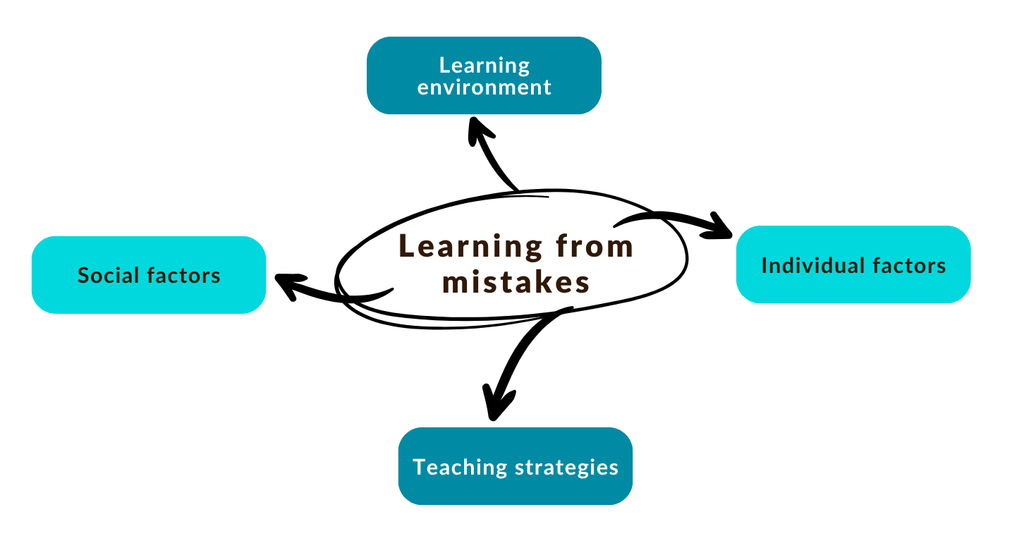
Psychological safety and a positive error climate create the basis for students to learn from their mistakes. Social factors like this include support by lecturers and fellow students, for example. When mistakes occur, everyone involved should work through them together. That way, it is not only the person who made the mistake that learns from it but the students who are involved in the process and help analyse the mistake as well. Oser refers to this process as “advocatory learning”. Students do not have to make mistakes themselves to learn from them. They can also learn from other people’s mistakes – through peer feedback, case studies or historical events, for example (Oser, 2017).
Furthermore, individual factors also shape how mistakes are dealt with (Narciss & Alemdag, 2025). How students react to mistakes depends on their self-efficacy, emotional regulation, motivation (Tulis et al., 2016) and openness to feedback. Some students construe mistakes as personal failure. They then feel frustrated or ashamed. They hide their mistakes and avoid situations where they could fail. As a result, they miss out on the opportunity to take a critical look at their thought processes and strategies for finding solutions and to develop their skills further. When students have a low opinion of their abilities, lack motivation and have little self-confidence, they are less likely to see mistakes as learning opportunities. They then avoid addressing them. Students who are highly motivated and willing to put in the effort, on the other hand, are more likely to use mistakes to revise their approach and expand their knowledge (Narciss & Alemdag, 2025). Lecturers need to take the effects of individual factors into account. A positive error climate, psychological safety and a supportive learning environment help to ensure that all students can benefit from the learning potential of mistakes.
In a supportive learning environment, lecturers and students see mistakes as learning opportunities and reflect on them systematically. That way, lecturers divert the attention towards the learning process. They make it clear that the focus is not on the mistake itself but on dealing with it (Narciss & Alemdag, 2025). First of all, lecturers and students work together to clarify what happened and why. After that, they discuss which assumptions were false and what they can do differently in future. Lecturers should specifically contrast correct and incorrect solutions and make the correct approach clearly visible. Students need to identify which approach is correct and why. Oser (2017) refers to this as “negative knowledge”. When students understand why certain approaches miss the target, the learning content becomes more deeply embedded in their minds. Remembering incorrect approaches helps them deliberately choose the right one later on.
Lecturers need to factor in enough time for this error analysis. After the analysis, students apply the new knowledge to other tasks. Memory aids and repetition help them consolidate the correct approach. That way, learning from mistakes becomes a structured process that students can learn and use for their learning in future.
Lecturers support this process with appropriate teaching strategies, which include suitable tasks and constructive feedback (Narciss & Alemdag, 2025) that encourages independent reflection and self-correction whilst also fostering the development of metacognitive strategies (Tulis et al., 2016). Under the following link you will find a suggestion for an exercise that can be used across various academic disciplines and in different types of courses: Suggested exercise.
Exercises may include typical misconceptions or problematic approaches to solving problems, specifically prompting students to deal with mistakes and learn from them. Therefore, the students analyse and reflect on a mistake they have not made themselves.
In the feedback process, lecturers should give students the opportunity to check their own work and reflect on their approach so that they can practise identifying and correcting their own mistakes. Lecturers and students can subsequently discuss the approach together. That way, they identify problematic learning paths and develop more effective strategies for future tasks.
What has your experience of learning from mistakes been? How do you deal with your own mistakes? Please feel free to share your experiences on LinkedIn.
Transparency Note
- Claude Opus 4.8: Text smoothing and spell-checking
- Featured image: tehcheesiong, de.123rf.com
- Photo: 9dreamstudio, de.123rf.com
- Infographic: created with Canva
- English translation: Fa Nowak, Regensburg
References
Edmondson, A. (1999). Psychological safety and learning behavior in work teams. Administrative Science Quarterly, 44(2), 350–383. https://doi.org/10.2307/2666999
Edmondson, A. (2011, April). Strategies for learning from failure. Harvard Business Review, 89(4), 48–55.
Edmondson, A. (2024). Wertvolle Fehler – Right kind of wrong. Die praktische Wissenschaft des klugen Scheiterns. Vahlen.
Harteis, C., Bauer, J., & Heid, H. (2006). Der Umgang mit Fehlern als Merkmal betrieblicher Fehlerkultur und Voraussetzung für Professional Learning. Revue suisse des sciences de l’éducation, 28(1), 111–129.
Narciss, S., & Alemdag, E. (2025). Learning from errors and failure in educational contexts: New insights and future directions for research and practice. British Journal of Educational Psychology, 95(1), 197–218. https://doi.org/10.1111/bjep.12716
Oser, F. (2017, 19. Oktober). Aus Fehlern (nicht) lernen – Über die Funktion des Falschen und die Fehlerkultur in der Schule [Video]. Freiburg Advanced Center of Education. School of Education. https://www.face-freiburg.de/mediathek/ringvorlesung1718-oser/
Steuer, G., Rosentritt-Brunn, G., & Dresel, M. (2013). Dealing with errors in mathematics classrooms: Structure and relevance of perceived error climate. Contemporary Educational Psychology, 38(3), 196–210. https://doi.org/10.1016/j.cedpsych.2013.03.002
Tulis, M., Steuer, G., & Dresel, M. (2016). Learning from errors: A model of individual processes. Frontline Learning Research, 4(2), 12–26. https://doi.org/10.14786/flr.v4i2.168
Suggestion for citation of this blog post
Rottmeier, S. & Puppe, L. (2026, September 17). Error culture as a driver for learning. Lehrblick – CTL Uni Regensburg. https://doi.org/10.5283/ZHW.20260917.EN

Stephanie Rottmeier

Linda Puppe
Dr. Linda Puppe is a research assistant at the Centre for University and Academic Teaching (ZHW) at the University of Regensburg. She focuses on the topics of innovation in teaching and motivation. Furthermore, she is interested in digital learning environments.