



Outside, the sun is shining down from a blue sky and the thermometer is showing pleasant temperatures. And here you are, standing in the seminar room trying to spark a discussion among your students. But it’s hot and stuffy in the room, so their level of attention and motivation is low. And then the thought occurs to you: why on earth are we still sitting in here?
Many lecturers have had this thought without questioning it further. Teaching happens indoors, after all – that’s just the way it is. But what if we were to challenge that assumption and move teaching outdoors: group work, fishbowl discussions or reflection phases in the open air? Higher education outdoors as another space to open up new, creative possibilities.
When we speak of teaching outdoors, we do not mean field trips, scientific experiments in the open air or survival training in the wilderness – we mean something much simpler: teaching and learning out in the open (Parker, 2022).
Teaching outdoors offers added value for everyone involved.
Teaching outdoors can be used as a conscious response to the fatigue associated with highly digitised (university) teaching (Walter, 2013). Furthermore, it offers students a wide variety of other advantages (Hernandez, 2024; Parker, 2022; Fleischmann, 2025). Being outside has a positive effect on physical and mental health. It strengthens the immune and cardiovascular systems as well as the musculoskeletal system and facilitates physical activity. It reduces stress and mental fatigue and boosts motivation. Students report experiencing significantly higher levels of positive emotions (Mateo-Canedo et al., 2023).
Cognitive development, memory and academic performance also benefit. Learning outdoors fosters creativity, problem-solving skills and critical thinking and improves your ability to concentrate. Furthermore, it has also been proven that school pupils are able to remember what they have learned more easily due to its connection to a physical experience and sensory impressions (Parker, 2022). In the study conducted by Mateo-Canedo et al. (2023), students rated the subjective learning gains from teaching outdoors as just as high or slightly higher than when teaching occurs indoors.
Breaking up traditional seating arrangements – where students usually sit at rows of desks in seminar rooms – dismantles barriers, which fosters cooperation and interaction and leads to greater participation among the students. At the same time, the environment creates a feeling of equality and closeness to the teacher.
Even though the research on the added value for teachers is significantly more limited, there are nevertheless studies that report a higher degree of job satisfaction alongside the positive effects on physical and mental health, for example – effects which apply to both teachers and students (Parker, 2022; the studies referenced there relate to school teachers).
And the good news is that you don’t need any fancy equipment to take your teaching outdoors.
Teaching outdoors can be achieved using simple means.
Several universities have created outdoor learning and work areas by now, equipped with weatherproof (standing) tables, seating, whiteboards and Wi-Fi, for example. With its “Outdoor Campus”, KU Eichstätt provides its lecturers with what is probably the most comprehensive range of facilities in the German-speaking world: it offers a variety of didactically designed outdoor learning and teaching spaces supplemented by detailed recommendations for use and special training courses for lecturers. There are also specially equipped outdoor seminar rooms available at other universities, including the University of Wuppertal and Heidelberg University of Education. Learning and work spaces like this are ideal of course – it is very easy here to take courses outdoors with very little effort.
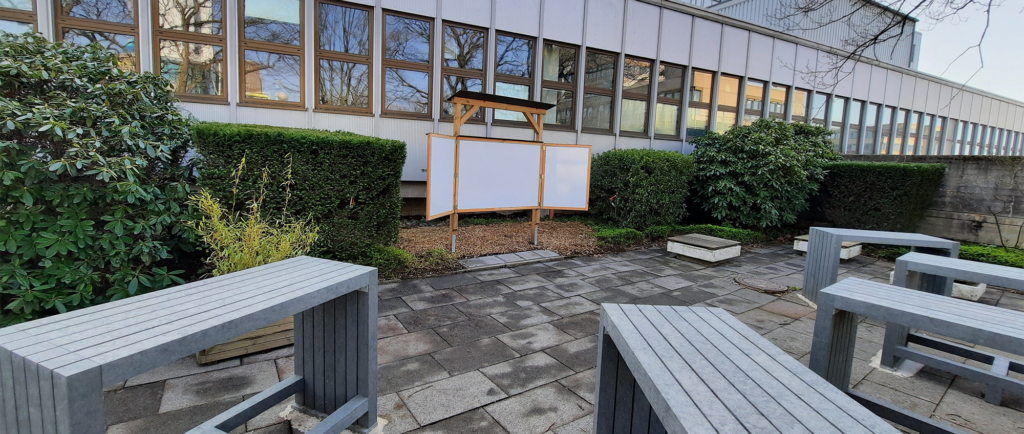
But even without these specially equipped areas, the effort involved in holding a course session outdoors is manageable: universities often have areas with fixed seating – even in quiet locations that are less frequented. These areas lend themselves very well to being used for this purpose. The Technical University of Munich, for example, has put together a detailed booklet listing different suitable locations.
In the simplest case, it is enough to have a lawn with picnic blankets laid out on it. For individual sessions outdoors, that is perfectly sufficient. For lecturers who would like to take their teaching outdoors regularly, a mobile “seminar room-to-go” packed into a small trailer or handcart would be a good idea. This could include a mobile flipchart, mini whiteboards complete with pens and cleaning rags, floor mats, a parasol and sun cream, for example.

Teaching outdoors lends itself to a wide variety of teaching methods.
The entire session can be held outdoors or just certain parts of it – the first part could be held in the seminar room for the students to do individual work, for example, and the second part could involve a walk and talk in pairs outdoors. In principle, teaching outdoors is suitable for a wide range of methods that go far beyond simply taking a lecture outside (Böttger et al., 2024; Fleischmann, 2025):
- Discursive and cooperative scenarios, including walk and talk, think-pair-share and jigsaw. Open spaces are ideally suited to these methods due to the fact that there is more space available and that there is also the option of changing locations quickly. In addition, it is easier to regulate how loud the discussion is outdoors by increasing the distance between groups.
- Reflection phases and individual consolidation, such as quiet reading, time for writing, and reflective walks. If there are quiet outdoor spaces within easy reach, it would make sense to use these for periods of concentrated work.
- Exploratory and practical scenarios (e.g. learning stations or treasure hunts): Tasks have to be completed at set points in the surroundings or information has to be sought. Movement between the stations forms an integral component of this.
- Presentations and role play: These scenarios generally require specially designed locations, so it is primarily spaces offering a stage and amphitheatre-style seating that are suitable for lectures or presentations.
Teaching outdoors involves hurdles.
It is not only the weather that can throw a spanner in the works. Lecturers face various challenges if they move their teaching outdoors (Fleischmann, 2025). Not all teaching content is suitable; special equipment is required to teach certain topics – for experiments in the natural sciences, for example. Outdoor spaces are also generally unsuitable for discussions of sensitive topics or for examinations. In addition to these content-related limitations, there are, above all, organisational limits: apart from bad weather or unsuitable seasons, these include a lack of suitable spaces, poor accessibility, limited technical infrastructure and ergonomics, and also limits to group sizes due to poor acoustics. Depending on the individual situation, this can also result in more work for teachers and students – because of materials needing to be carried outside and set up, for example.
There are good solutions for dealing with some of these hurdles: any uncertainties lecturers may have can be addressed accordingly through further training, for example. And the limited technical infrastructure does not have to be an obstacle but can increase attention and mobilise positive emotions by the focus being on the basics (Mateo-Canedo et al., 2023).
Summer is just around the corner.
Teaching outdoors is currently enjoying a niche existence, which is quite unjustified when you consider the added value for everyone involved and the relatively small amount of extra effort required. So, what we would suggest is just to give teaching outdoors a go – by trying a walk and talk, for example.
References
Böttger, H., Höppner, B., Hoffmann, T., Reichel, A., Stadler-Heer, S., & Steinbach, A. (2024). Englisch draußen lernen: Raus aus den Klassenzimmern und Seminarräumen (Schriftenreihe Fachdidaktik Englisch, Bd. 2). Katholische Universität Eichstätt-Ingolstadt. https://doi.org/10.17904/ku.edoc.33956
Fleischmann, A. (2025). Der grüne Seminarraum – Lehren und Lernen im Freien. In B. Berendt, A. Fleischmann, N. Schaper, B. Szczyrba, & J. Wildt (Hrsg.), Neues Handbuch Hochschullehre (Beitrag B 1.8). Franz Steiner Verlag. https://doi.org/10.25162/NHHL-2025-0007
Hernandez, H. H. (2024). Let’s take this outside: Rethinking outdoor education. Journal of Education and Learning, 13(5), 172–178. https://doi.org/10.5539/jel.v13n5p172
Mateo-Canedo, C., Crespo-Puig, N., Cladellas, R., Méndez-Ulrich, J. L., & Sanz, A. (2023). MOTEMO-OUTDOOR: Ensuring learning and health security during the COVID-19 pandemic through outdoor and online environments in higher education. Learning Environments Research, 26(3), 823–841. https://doi.org/10.1007/s10984-023-09456-y
Parker, L. (2022). Outdoor learning, a pathway to transformational learning? Or another educational gimmick? International Journal for Cross-Disciplinary Subjects in Education, 13(1), 4600–4611. https://doi.org/10.20533/ijcdse.2042.6364.2022.0565
Walter, P. (2013). Greening the net generation: Outdoor adult learning in the digital age. Adult Learning, 24(4), 151–158. https://doi.org/10.1177/1045159513499551
Suggestion for citation of this blog post
Bachmaier, R. (2026, May 14). Out onto the grass: Teaching outdoors. Lehrblick – ZHW Uni Regensburg. https://doi.org/10.5283/ZHW.20260514.EN

Regine Bachmaier
Dr. Regine Bachmaier is a research associate at the Centre for University and Academic Teaching (ZHW) at the University of Regensburg. She supports teachers in the field of “digital teaching”, among other things, through workshops and individual counseling. In addition, she tries to keep up to date with the latest developments in the field of “digital teaching” and pass them on.