

Is it the same for you? It feels like the demands on degree programmes are growing by the day: differentiated prior knowledge and study goals, sustainability as a cross-sectional theme, digitisation and the opportunities and challenges AI brings with it – the to-do list is getting longer and longer. In this context, universities are honing their profiles. The intention is for the strategic objectives to be reflected in the further development of degree programmes.
This is counteracted by structures that cannot be changed overnight. Degree programmes and their conceptual and normative core – the curricula – have developed as a result of committee processes that are time-consuming and sometimes protracted.
It takes time to develop curricula. And this stands in the way of the dynamic demands of the external environment. Nevertheless, these demands should be reflected in the curricula, as degree programmes also have the mandate to prepare graduates for the complex and global challenges of the future and equip them to act professionally and responsibly in a particular profession or professional field or in society in general.
How universities deal with the current demands on degree programmes
There are various strategies that universities apply to reflect strategic goals and themes in their curricula or to integrate them into their curricula (see Table 1).
| integrative approach | additive approach | |
| course and module level | integration into specific courses or subject modules | new structures alongside the core curriculum – modules in electives, designed to be interdisciplinary extracurricular options: certificates, microcredentials |
| degree programme level | cross-sectional and longitudinal interweaving with the curriculum | special degree programmes (MA) |
The demands for change outlined above are so extensive and pervasive throughout all areas that simply adding individual ‘future-oriented’ modules to a curriculum (whether these are extracurricular or integrated into the curriculum) only seems to be promising or forward-looking to a limited extent, even if it is a good first step to take to address these themes.
If you want to make sure that all students acquire certain skills, there is no way past interweaving these themes with the curriculum – it is not for nothing that we speak of cross-sectional themes here. This is also supported by a core principle of didactics and learning psychology: practical competency is acquired through concrete and complex real-life situations. In daily professional life, issues like sustainability, accessibility or the use of AI are not treated as an afterthought or add-on, but are included in problem analysis and solution-finding from the very start. It should be exactly the same in higher education.
What obstacles are there on this path and how can they be overcome?
On the one hand, you have the call for the strategic further development of degree programmes as a whole, while on the other you have the lecturers working in the context of specific subjects and modules. How can a link be established between subject-specific and interdisciplinary/strategic themes and top-down and bottom-up perspectives, and how can this be supported by effective processes? And what obstacles need to be overcome in the process?
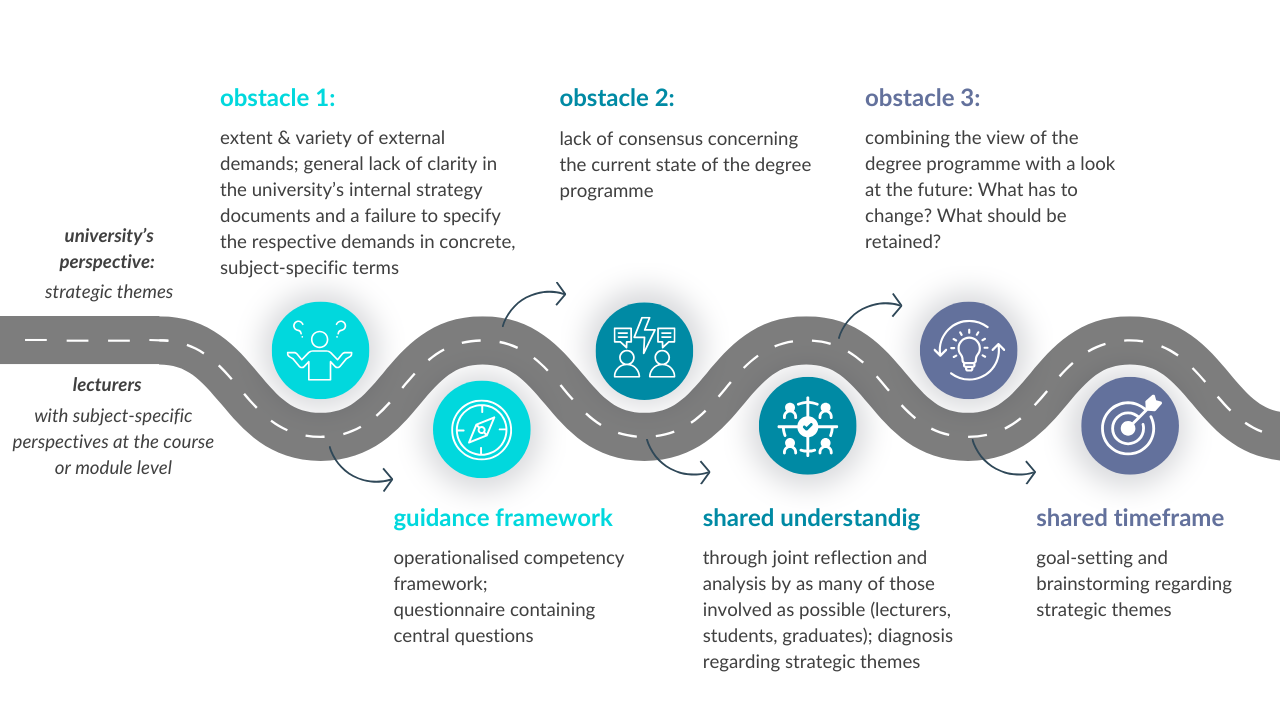
Obstacle 1: Spoilt for choice
When it comes to aligning curricula with the university’s strategic objectives, the first big hurdle lies in the extent and variety of external demands coupled with a general lack of guidance and clarity in the university’s internal strategy documents and/or a failure to specify the respective demands in concrete, subject-specific terms.
What is needed here is a guidance framework and a scope for the project that provides a kind of guardrail for thinking and, as far as possible, already covers all the strategic themes that should be taken into account from the university’s perspective. This could be an operationalised competency framework in the form of a skills matrix or catalogue of skills, or a questionnaire containing central questions.
If the university is to play a guiding and orientating role in this regard, it therefore makes sense to clarify certain issues before embarking on curriculum development work at the university level or in the faculties/departments. At the content level, the strategic themes should ideally be operationalised in a moderated, university-wide process within one guiding framework that is in alignment with the university’s desired profile characteristics, in order to make these manageable and thus facilitate curriculum development work in the degree programmes.
In this regard, please refer to the university-wide process at Aachen University of Applied Sciences, which led to the creation of a common framework – the Framework Questionnaire – and, as a result of this preliminary clarification process, managed successfully to get all departements on board. Even if they do not have a university-wide process of their own, other universities can now use this questionnaire and adapt it to fit their own needs.
The following overview contains examples of reference frameworks for interdisciplinary competencies for degree programmes:
- Examples of a university-specific orientation framework: Aachen University of Applied Sciences Framework Questionnaire and Skills matrix for degree programme development at HAW Hamburg
- Example of a competency framework that spans different higher education institutions and in which current future requirements have been translated into and systematised as interdisciplinary skills: Future Skills 2030
- Overview of competency frameworks and definitions of the various interdisciplinary competencies and future skills: FutureSkills4U
Once the scope of the project is clear, we can get started on the strategic review, can’t we? Not quite. The development work proper, which takes place as part of the curriculum process – in curriculum workshops, for example – still has to clear two more hurdles first. Both require a supportive framework within a structured process (see the framework process at Aachen University of Applied Sciences).
Obstacle 2: Lack of consensus
The reality of a degree programme is perceived differently depending on the lecturer’s academic perspective, which is based on his/her own research specialism and teaching responsibilities. Those who are in the best position to view the degree programme as a whole are the programme directors and deans – and, from an internal perspective, the students and graduates.
The first step, therefore, is to establish a shared understanding of the current state of the degree programme among as many lecturers as possible, combined with an assessment: What is already in place? What can we build on, and where is there need for development and adjustment?
Tools like the framework questionnaire or a skills matrix can be used as self-assessment tools here to facilitate curriculum mapping. It is usually very gratifying for those involved in the process to discover how much is already being implemented (often implicitly). This step is a good opportunity to expand the more individual perspectives of individual lecturers into a holistic view of their own degree programme and to (continue to) explore together how the programme has worked to date: Who actually does what in which module, and why?
This helps to make the design principles of the programme and the overall teaching concept more clearly identifiable with regard to the qualifications graduates are expected to achieve. It is extremely helpful to involve students and/or graduates at this stage, as they have a broad perspective gained from experiencing the overall context of knowledge input, learning tasks, assessments and examinations.
Obstacle 3: The shared timeframe
The next step is to combine our view of the degree programme with a look at the future: What ought to change and what has to change? What should be retained? What implications does this have for the curriculum development process? Do we need ‘reworked’ or supplementary modules, or is what we actually need a completely new degree programme concept, because old teaching approaches no longer meet the new requirements? Which topics from the catalogue of cross-sectional themes will be selected and to what extent, and what tried-and-tested approaches and other ideas for implementation already exist?
If it has not already been done, an intermediate step is sometimes necessary here, which is a substantive assessment of the topics of change themselves.
Six recommendations for the process: A holistic approach to degree programme strategy and integration
Once the prerequisites have been met, the curriculum development process proper can begin. From the perspective of a process facilitator of curriculum development processes, I would like to offer six recommendations, which are based on the following premise.
Curriculum development processes are change processes. Change processes are learning processes. People have to rethink things and subsequently act differently from before in most cases. This has implications for the process design of programme development, which only looks like a redesigning of ‘structures’ on the surface.
1) Turn it into a project!
For academic staff at universities, curricular processes are always extra activities that come on top of what is already a busy research and teaching schedule in most cases. At the same time, they should not be treated as an afterthought, as they run the risk of unravelling and fizzling out. A project structure provides a clear framework in terms of both timing and organisation as well as defining roles (steering group, project coordination, development team(s), process facilitation, etc.).
2) Allow plenty of time – and start early!
Curriculum development processes should be viewed as iterative rather than linear. They can be visualised in five phases (see Figure 2; cf. Ionica et al., 2024, p. 15ff). In reality, there is usually a back-and-forth movement and interweaving of the individual stages. The ‘curriculum development’ project requires thorough preparation and then, in the individual stages, enough room for discussion, joint interpretation of reality (realities) and requirements, and negotiation and decision-making. Provision should be made along the way for further training for all staff here and there (e. g. the use of AI in teaching) or for testing prototype concepts (e. g. alternative assessments, examinations or project formats).
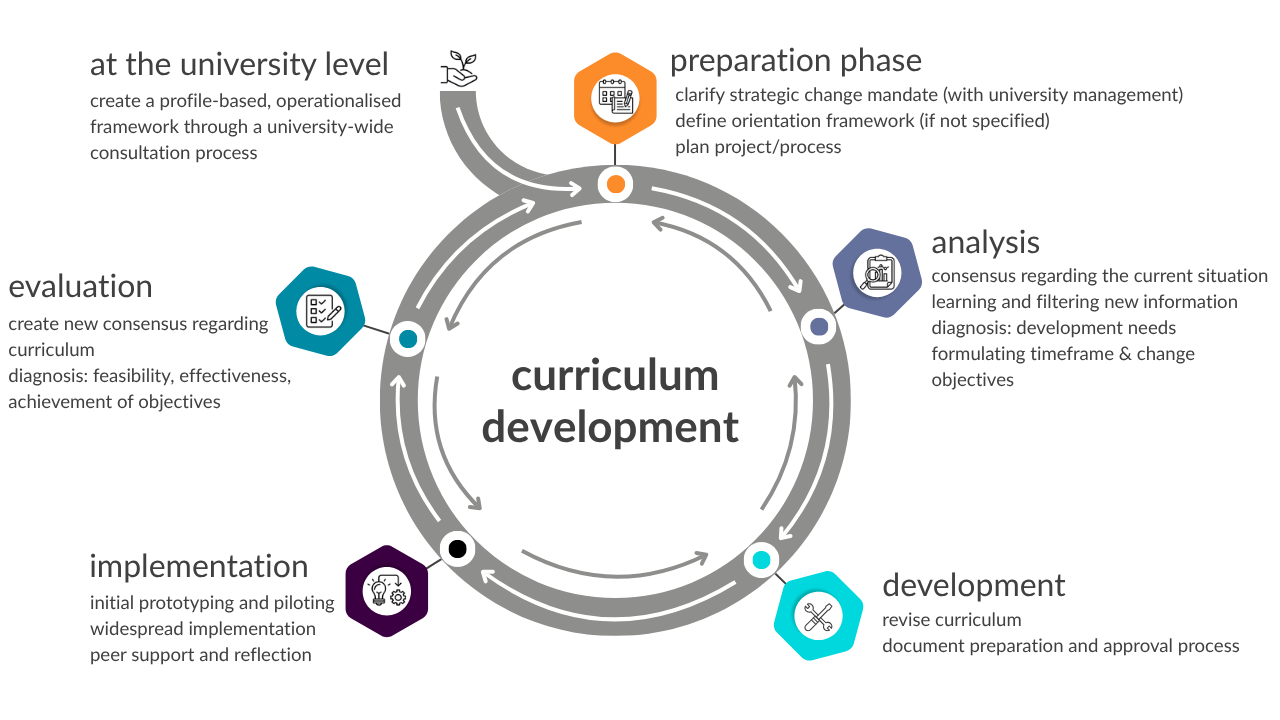
3) Involve people with their needs, perspectives and ideas – because they are the ones who are going to be implementing the changes!
We sometimes forget the most important thing: a curriculum is designed for students. They are the ones who are expected to acquire skills thanks to the newly designed teaching and learning concepts. Their perspective needs be taken into account from the start.
Lecturers, on the other hand, are the ones who transform a curriculum that has been designed into a curriculum that is lived. It is only natural that the earlier you are involved in a change and act as a kind of midwife to that change, the more personally involved and responsible you feel. The process of engagement and participation of all involved and of those ‘affected’ should always be considered and planned for. In light of the different interpretations of ‘freedom’ in teaching, there is also a need to raise awareness of the shared responsibility there is for a degree programme.
4) Use the resistance – it is the most basic form of cooperation and is twinned with change!
Resistance arises where change becomes tangible and, at the same time, points to an internal struggle with the change. The most important aspect of the curriculum development process is therefore the creation of appropriately structured and well-facilitated spaces for discussion and reflection – these are usually referred to as ‘curriculum workshops’ (Ruschin, 2021). Here, concerns, objections and perhaps even vetoes can and should be voiced and negotiated. Resistance manifests itself in various ways, and good process facilitators recognise it and know how to use it constructively. This is because it often conceals valuable information and perspectives that are worth incorporating.
5) Make sure there is a sense of security and stability throughout the process!
What do people need in uncertain situations? They need stability. Change – even if only imagined initially – creates uncertainty. A key task in the process is to strike the right balance. A sense of security and stability is created by the process having a clear framework and also by the individual working sessions, transparent communication (especially between sessions), clear responsibilities and well-defined decision-making processes, for example. Good project management and competent process support and facilitation are also of key significance here.
6) Treat curriculum development as a team process – so you can achieve more together!
What makes a degree programme is the people who design it – yet lecturers often work parallel to each other rather than with one another. They are united by a common goal, however: to provide students with the best possible qualifications through a degree programme for which they share responsibility.
The curriculum development process provides the opportunity to establish a shared understanding, to develop the module structure further in a way that makes sense, and thus to provide students with clear guidance for their own learning path. Coordination concerning objectives, content, teaching methods and examinations is not merely something nice to have – it is the key to coherence and quality. This not only strengthens the curriculum but also the team itself.
Most strategic issues are too complex to be tackled alone – they require co-creation: the exchange and use of different perspectives, skills, ideas and methodological approaches in order to develop sustainable solutions. And that is precisely what students should learn too. A strong programme team can serve as a role model here – a model for modern teamwork in an uncertain future. Students can become part of this team themselves, contributing their own perspectives. This brings us to the concept of the universitas – an idea that is old but still alive and kicking, and refers to the idea of a community of teachers and learners.
To achieve this, degree programme designers would be well advised not to plan and consider everything on their own but to seek professional support: the university’s teaching support staff and support structures for programme/curriculum development are the right places to go in this regard (Sames & Budde, 2024). If internal university resources should prove insufficient, external freelance consultants can also be called upon to ensure that the right aspects are addressed during planning or to provide support with the process itself.
References
Sames, J., & Budde, J. (2024). Curricula strategisch gestalten. In Hochschulforum Digitalisierung (Hrsg.), strategie digital (Ausgabe #05: Kooperative Curriculumentwicklung). https://hochschulforumdigitalisierung.de/wp-content/uploads/2024/10/SD05-01-Curricula-strategisch-gestalten.pdf
Ionica, L., Vissiennon, M., & Budde, J. (2024). Studiengänge für eine digitale Welt: Whitepaper zur Curriculumentwicklung als hochschulweiter Veränderungsprozess (HFD-Arbeitspapier Nr. 76). Hochschulforum Digitalisierung. https://hochschulforumdigitalisierung.de/wp-content/uploads/2024/02/HFD_AP_76_Studiengaenge_fuer_eine-_digitale_Welt.pdf
Hintze, P., Kluth, K., & Rätz, K. (2026). Hebel II: Curriculare Integration von Future Skills. In A. Lübben, J. Koeritz & H. Koch (Hrsg.), Future Skills stärken: Vier strategische Hebel für die Hochschulentwicklung (S. 11–14). Stifterverband. https://www.stifterverband.org/medien/future_skills_staerken
Ruschin, S. (2021). Expertenaustausch auf Augenhöhe: Beitrag der Hochschuldidaktik zur Curriculumentwicklung. In R. Kordts-Freudinger, N. Schaper, A. Scholkmann & B. Szczyrba (Hrsg.), Handbuch Hochschuldidaktik (S. 363–378). wbv Publikation. https://doi.org/10.36198/9783838554082
Suggestion for citation of this blog post
Vissiennon, M. (2026, June 18). Curriculum development: How does strategy find its way into the curriculum? Lehrblick – ZHW Uni Regensburg. https://doi.org/10.5283/ZHW.20260618.EN

Marit Vissiennon
Marit Vissiennon, MA, has been working in the field of curriculum development for the past 10 years and has supported numerous teaching and curriculum development processes. She gained her expertise working as a research assistant in higher education didactics at the University of Leipzig and, most recently, at the Technical University of Cologne, for example. She is currently working on a freelance basis, supporting and advising lecturers, teaching teams and higher education didactics teams both in Germany and abroad with a view to designing impact-orientated educational and curricular change processes.