



Cognitive psychology studies the mental processes involved in processing information. As a basic science, its orientation is highly experimental, focusing on cognitive processes like memory, attention, reasoning and judgement. From a didactic perspective, many of these processes are hugely informative: someone who understands how attention, information processing and memory work can design teaching and learning settings specifically to promote long-term learning (Agarwal & Roediger, 2018). Therefore, applied cognitive psychology also investigates the extent to which experimental results from controlled laboratory conditions can be applied to practical everyday situations (Rummel & Janczyk, 2024).
The interleaving effect and retrieval practice are among the strategies that are particularly relevant to higher education. Both address key challenges involved in academic learning: not just making knowledge available in the short term but retaining it in the long term and applying it flexibly in new contexts. This is precisely where their didactic potential lies, because both strategies have been well researched in cognitive psychology. At the same time, they are compatible with the typical requirements of teaching at university and can be integrated into various teaching formats with minimum effort.
Interleaving and retrieval practice: The ideal approach in teaching?
The interleaving effect describes the finding that learning success is greater when different concepts are arranged as a mixed bag rather than focusing on a single concept as a block. Penn (2024) illustrates this by way of an example:
Let us assume that students are to learn about the ways stimulant substances like amphetamines, cocaine and caffeine work. Following the principle of blocked learning, students first work on one example (e.g. amphetamines) in full, learning subtopics such as chemical composition, their effects on the nervous system or their psychological effects. Finally, they would then work on the next substance.
If lecturers organise the material in a way that is interleaved, on the other hand, it is precisely those subtopics that they focus on. They first compare the different chemical compositions of the individual substances, then examine their respective effects on the nervous system, and conclude by comparing their respective psychological effects (see Figure 1).
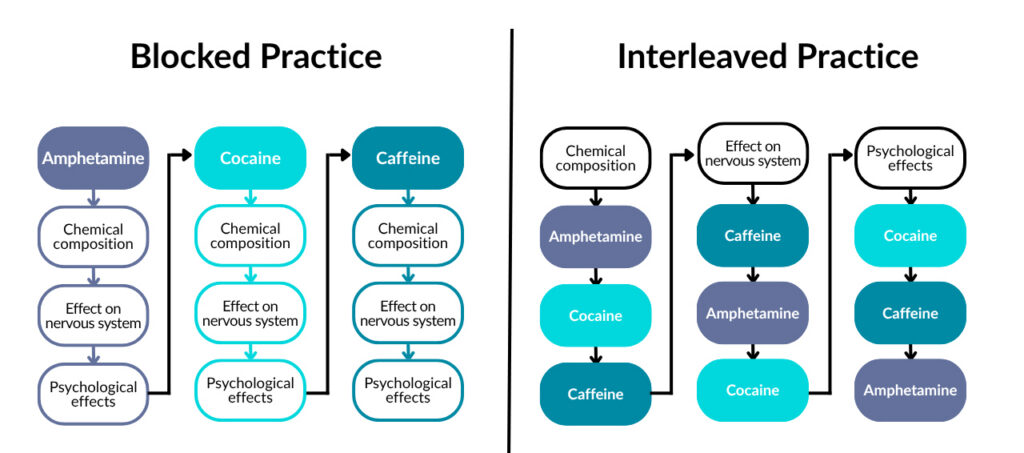
Figure 1. Blocked versus interleaved practice
Retrieval practice refers to a strategy by which knowledge is actively retrieved from the memory instead of content simply being repeated. The focus is not on the repeated presentation of knowledge but on the independent attempt to remember what has already been learned. What is key is that learners have to reconstruct content from memory without direct prompting.
In traditional repetition, a teacher would briefly summarise the key points from the previous session at the start of the new session. While this can also provide orientation, it largely leaves the cognitive activity to the teacher. Retrieval practice shifts the focus: instead of the content being presented again, students are encouraged to actively recall what they have already learned – by doing a short quiz, for example. It is precisely this active retrieval that is effective for learning, as it makes knowledge available in the long term and facilitates its application later.
There is now a wealth of evidence supporting the effectiveness of interleaving and retrieval practice. In a review article, Yan et al. (2023) summarise different meta-analyses that underline the positive effect of these cognitive strategies in a way that is striking. With an average effect size of g = 0.42, students using interleaved practice performed significantly better in final tests than the comparison groups using blocked practice. The benefits of retrieval practice are even greater. Here, learners improved their test results by half a standard deviation (g = 0.50) by using retrieval practice.
These results are by no means new or surprising. Mörth et al. (2021) refer to decades of research in these areas. In light of such robust findings, Roediger and Pyc (2012) recommend the use of methods like interleaving or retrieval practice as an effective and simultaneously cost-effective way of supporting learning processes from nursery school all the way to higher education.
The findings actually sound as if there is not much you can do wrong using these methods. Unfortunately, however, despite robust evidence, it is not a question of a one-size-fits-all solution that is guaranteed to lead to success in all teaching situations. That is because the meta-analyses synthesise various individual studies. As an average across all studies, they show significant effects for both methods. This does not mean, however, that they do not also include individual studies where interleaving and retrieval practice did not deliver the expected added value or where they even led to poorer results.

No easy solution to complex problems
What sounds like contradictory evidence at first glance can be explained by analysing the learning processes underlying the use of these methods (Yan et al., 2023). In real-life situations, learning is far more complex than can be indicated in experimental studies. It is therefore important to consider what works for whom and when, and to understand the underlying cognitive processes.
In the case of interleaving, different concepts are presented side by side. Students’ attention is therefore directed towards the features that distinguish these concepts from one another. When examples from the same concept are presented in clusters (blocking), however, attention is directed towards the essential features that characterise the respective concept and pull it all together. Interleaving is therefore not an end in itself but only makes sense when the goal is for students to recognise differences between various concepts. Learners have to recall and apply their knowledge repeatedly. This strengthens their ability to distinguish between concepts.
However, if this task becomes too complex, the effect is reversed. If there is too little prior knowledge, for example, too many topics will be mixed together or there will be a constant switching from one topic to another. This increases the cognitive load and therefore tends to make learning more difficult. The additional load can lead to frustration or superficial understanding.
The same applies to retrieval practice. Low-threshold retrieval exercises (e.g. short, unmarked tests) help to show the level of knowledge. However, this is only effective if learners already have a sound, fundamental understanding. Otherwise, retrieval practice is of little use or can even be counterproductive, as nothing relevant can be activated without a sound knowledge base. The timing and frequency of retrieval exercises are also key: one act of retrieval does not lead to a learning effect that is lasting. For retrieval to be effective in the long term, learners must retrieve content repeatedly and at increasingly longer intervals (spacing effect).
Lecturers’ didactic expertise is key
With its predominantly experimental approach, cognitive psychology research provides valuable insights into the mechanisms that are suitable for stimulating specific cognitive processes. Nevertheless, none of these recommendations automatically leads to effective learning under any circumstances. What is far more crucial is the question of the circumstances in which a strategy actually fosters learning. What is important here is primarily the students’ prior knowledge and the intended learning outcome.
Strategies that are very suitable for beginners can hinder the learning success of more advanced students – and vice versa (expertise reversal effect). In this context, the lecturer’s professional expertise is of key importance: their in-depth knowledge of the subject and their continuous reflection enable them to adapt teaching strategies in a manner that is targeted, rather than resorting to ‘one-size-fits-all’ approaches.
References
Agarwal, P. K., & Roediger, H. L. (2018). Lessons for learning: How cognitive psychology informs classroom practice. Phi Delta Kappan, 100(4), 8-12.
Mörth, M., Paridon, H., & Sonntag, U. (2021). Kognitionswissenschaftliche Erkenntnisse und ihre Folgerungen für evidenzbasierte Hochschullehre. die hochschullehre, 7(5), 38–48. https://doi.org/10.3278/HSL2105W
Penn, P. (2024). Interleaving: how it can help you study more effectively. YouTube. https://www.youtube.com/watch?v=gmy3xhiVw90
Roediger, H. L. III, & Pyc, M. A. (2012). Inexpensive techniques to improve education: Applying cognitive psychology to enhance educational practice. Journal of Applied Research in Memory and Cognition, 1(4), 242–248. https://doi.org/10.1016/j.jarmac.2012.09.002
Rummel, J., & Janczyk, M. (2024). Angewandte Kognitionspsychologie: Ein Lehrbuch. Kohlhammer. https://doi.org/10.17433/978-3-17-042016-8
Yan, V. X., Sana, F., & Carvalho, P. F. (2024). No simple solutions to complex problems: Cognitive science principles can guide but not prescribe educational decisions. Policy Insights from the Behavioral and Brain Sciences, 11(1), 59–66. https://doi.org/10.1177/23727322231218906
Suggestion for citation of this blog post
Hawelka, B. (2026, April 16). The devil is in the detail: Cognitive strategies in higher education. Lehrblick – ZHW Uni Regensburg. https://doi.org/10.5283/ZHW.20260416.EN

Birgit Hawelka
Dr. Birgit Hawelka is a research associate at the center for University and Academic Teaching at the University of Regensburg. Her research and teaching focuses on the topics of teaching quality and evaluation. She is also curious about all developments and findings in the field of university teaching.